The project was first installed through UAAO (The United Asian American Organizations) at the University of Michigan’s Diag, one of the campus’s most active public gathering spaces, and later exhibited at an event hosted by Michigan Refugee Assistance Program.
Our team: Anurima Kumar, Danyel Tharakan, Emmen Ahmed, Zoya Zalatimo, and Zoha Bharwani.
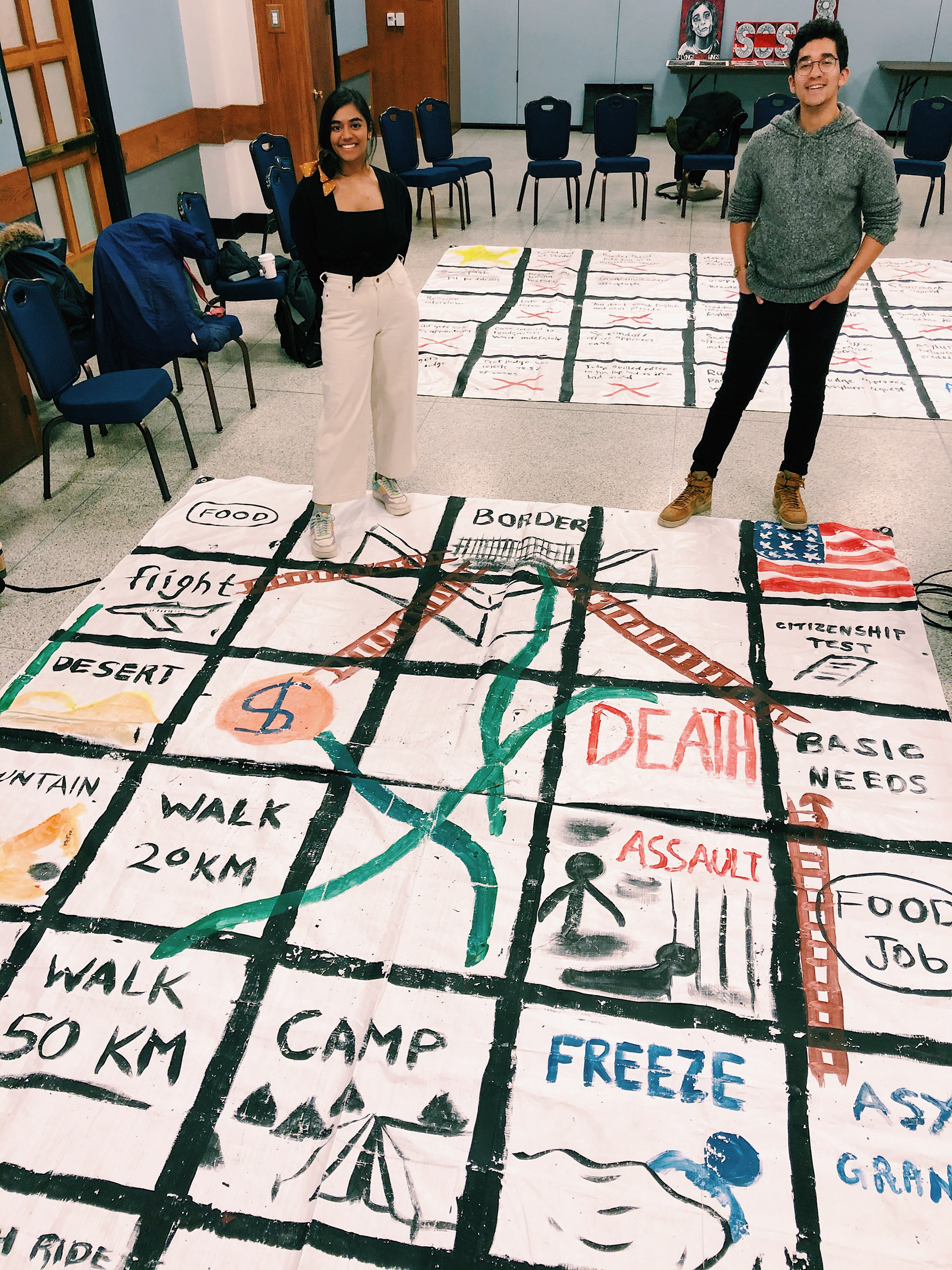
This interactive installation simulates two distinct but interconnected systems shaping refugee and asylum-seeking journeys: border migration and the asylum process. Participants begin by drawing a randomized “family profile,” which may include children (ages 0–teen) and/or a partner, emphasizing how migration experiences are shaped by family structure and identity.
In the border simulation, participants roll dice to determine movement through a path-based system. Standard dice outcomes are remapped (2–6 correspond to 1–3 movement spaces) to reflect constrained mobility and uneven access to opportunity. As participants land on different squares, facilitators guide scenario-based prompts that represent environmental risks, policy barriers, and survival decisions encountered along migration routes. Certain scenarios introduce critical trade-offs and outcomes shaped by context—for example, traveling with an infant through dangerous terrain may result in loss or harm. Access to support, safety, or advancement varies depending on assigned identity markers, highlighting how structural inequality impacts outcomes.
If participants successfully reach the end of the simulation, they are asked to complete a simplified citizenship test, underscoring the additional barriers embedded in formal processes of belonging even after arrival.
A parallel asylum simulation represents the prolonged legal process of seeking protection, which may extend up to five years or more. Progress is shaped by chance-based assignment of adjudicators and the level of legal or institutional support received upon arrival, emphasizing how outcomes can vary significantly despite similar claims or circumstances.
Together, the two systems are designed as participatory learning tools that surface the unevenness, uncertainty, and human impact embedded in migration and asylum systems, translating complex policy structures into embodied, experiential understanding.
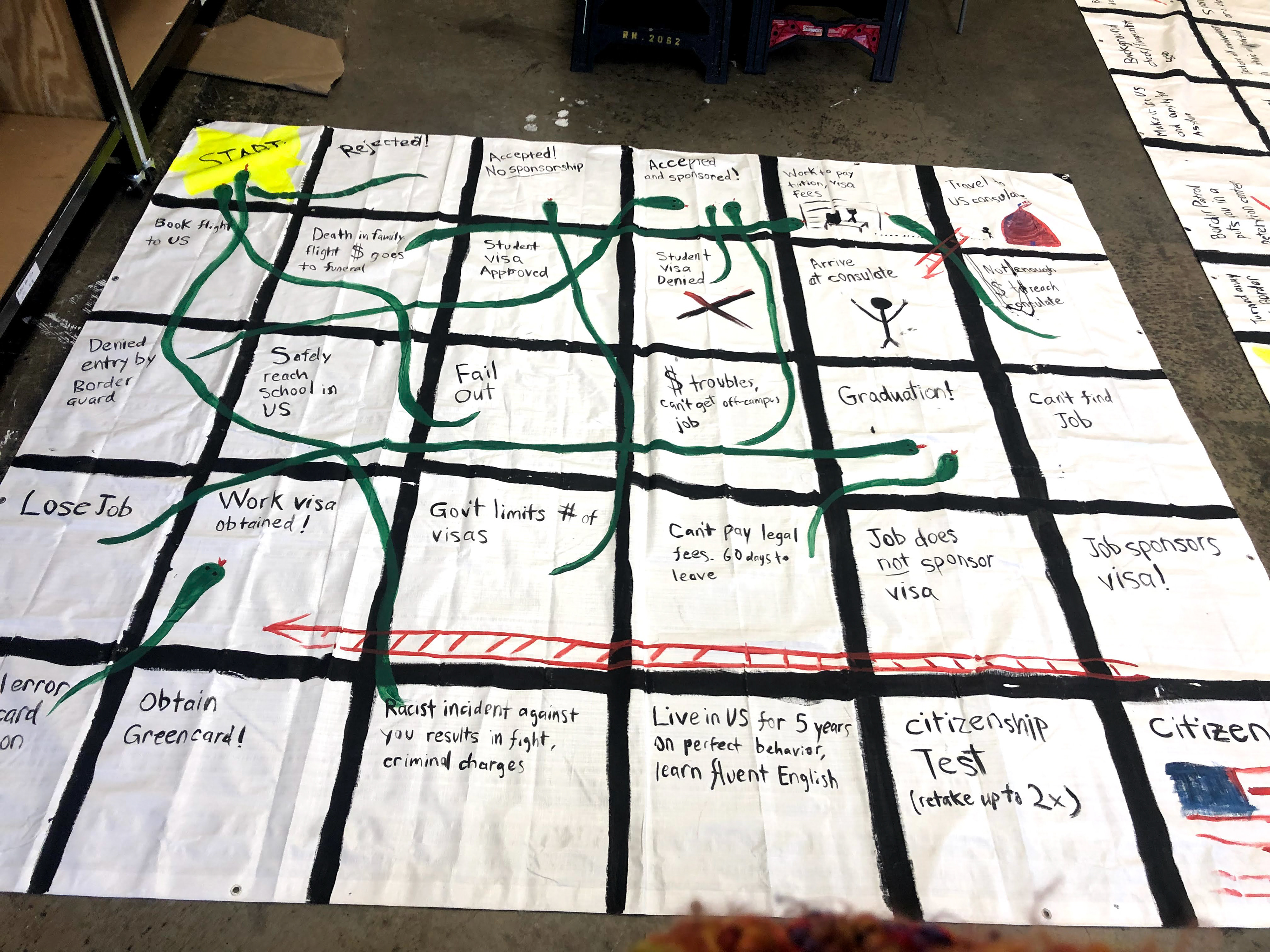
This interactive board game simulates the journey of a young adult immigrating to the United States for higher education, demonstrating different barriers to achieving citizenships than the asylum & refugee board.